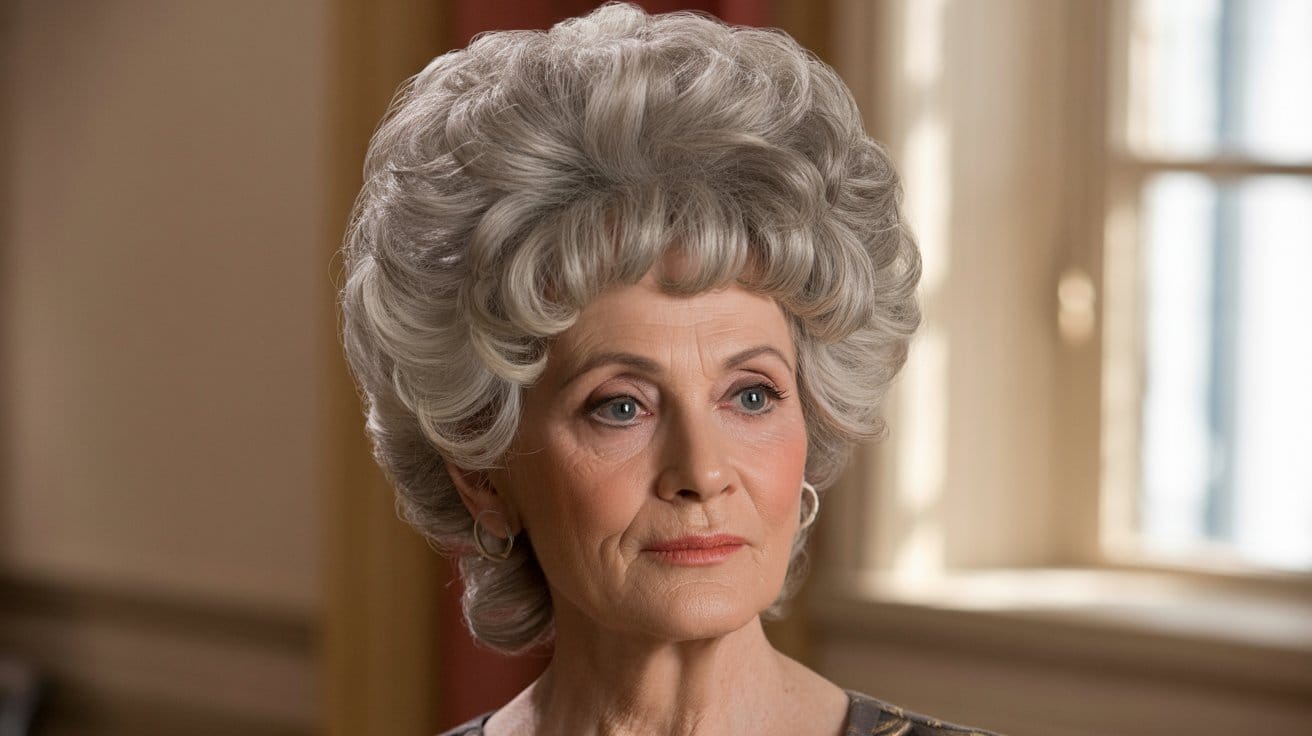
My grandmother walked into her salon at 72 and said the same thing she’d been saying for thirty years: “Just a trim, Pat.” And Pat — bless her — did exactly that every six weeks for years. Same cut. Same non-shape. Same “I’m not sure what to do with it so let’s do nothing” energy. My grandmother’s hair was fine, getting finer every year, and a trim wasn’t solving the underlying problem. The underlying problem was that she needed an actual HAIRCUT. Not a trim. A haircut designed for her hair RIGHT NOW at this stage of her life.
I tell you this because I know how many women over 70 are in the exact same situation. You’ve had some version of the same hairstyle for years. Your hair has changed — it’s finer than it used to be, maybe a little thinner at the crown, possibly a completely different colour than it was at 40 — but your haircut hasn’t changed to match. And the result is hair that looks somehow like a lot of work and not very much style simultaneously, which is genuinely the worst of both worlds.
Fine hair over 70 is not a hair problem. It is a haircut problem. With the right cut — one that works WITH fine hair instead of exposing its limitations — you can have hair that looks intentional, voluminous, stylish, and honestly younger than it has in years. The twenty styles below are exactly those cuts. Every single one was chosen specifically because it works beautifully on fine hair at this stage of life.
Go find your one. Show it to your stylist. Say “THIS one, please.”
Questions I Know You’re Already Wondering About
Why does fine hair get even finer after 70?
Two things happening simultaneously: hormonal changes reduce the diameter of individual hair strands, making each one physically thinner, and the hair growth cycle slows down so there are fewer active strands at any given time. Neither of these things is within your control. What IS within your control is the haircut, which can make fine hair look dramatically fuller through strategic layering, the right length, and volume-boosting techniques. The cut genuinely matters more than the products at this stage.
What is the single best haircut for fine hair over 70?
Short to medium length wins every time for fine hair. Here’s why: length is weight, and weight is the enemy of fine hair. When fine hair is long, its own weight pulls it flat — you end up with thin, flat strands that cling to your head and show every sparse area. At shorter lengths, fine hair defies gravity more easily, layers add genuine volume, and the overall look is much fuller. The sweet spot for most women is somewhere between the jaw and the collarbone.
Should I avoid layers if my hair is very fine?
No — but the TYPE of layers matters enormously. Very short, choppy layers on extremely fine hair can make it look sparser because they break up what little density you have. But longer, softer, blended layers that add movement without removing too much bulk are specifically designed for fine hair. Ask your stylist for “soft layers” or “wispy layers” rather than “choppy” or “heavy” layering.
Do highlights actually help fine hair look thicker?
Yes, genuinely. This is one of those hair tips that sounds like marketing but is actually true. When fine hair is a solid single colour, every strand reflects the same way and the scalp shows through more visibly. Highlights and lowlights create the illusion of depth and dimension — the eye reads the variation in tone as variation in hair density, which makes the hair look thicker than it is. Babylights and balayage through the front and crown are particularly effective for this effect.
Is gray hair harder to style if it’s fine?
Gray hair is actually slightly coarser in texture than pigmented hair, which means it can sometimes hold a style BETTER than it did before. The challenge is that gray or white hair can look flat if it’s uniformly one tone — but a toner, gloss treatment, or purple shampoo to add depth and dimension solves this immediately. Gray fine hair is completely workable with the right approach.
How often should I get a haircut if my hair is fine?
More often than you think. Fine hair at shorter lengths needs a refresh every four to six weeks to keep its shape. When fine hair grows out, the weight starts pulling the volume down faster than it does on thicker hair. If you’re currently going every eight to twelve weeks, try going every five to six and watch the difference in how consistently your hair looks the way you want it to.
20 Hairstyles for Over 70 with Fine Hair That Will Change Your Mind About Short Hair
1. Layered Bob with Side-Swept Bangs — The Classic That Always Works
 Photo via therighthairstyles.com
This is the haircut I would recommend first to literally any woman over 70 with fine hair who has never been quite sure what to do. The angled short bob with side-swept bangs and wispy layers is one of those rare cuts that checks every box simultaneously — it adds volume, it frames the face beautifully, it’s effortless to style, and it grows out gracefully between appointments.
The warm blonde balayage here is doing something important: it adds dimension to what might otherwise be a flat, single-tone result. When fine hair has highlights through it, the colour variation creates the visual illusion of depth and density. This is one of the most reliable tricks for making fine hair look fuller without changing anything about the actual cut.
The side-swept bangs are a gift for anyone who wants to soften features and add movement at the front. They’re also low-pressure to maintain — they fall naturally with a quick blow-dry and don’t need precise trimming the way a full fringe does.
Why it works for fine hair: The angled shape means the hair builds weight gradually as it moves toward the front, which is exactly where you want volume for framing the face. The layers add texture without removing too much density.
What to tell your stylist: “Angled bob, side-swept bangs, wispy layers. I want it shorter at the back and gradually longer toward the front. Add warm highlights through the top.”
2. Dimensional Bob with Feathered Layers — Look 10 Years Younger
 Photo via therighthairstyles.com — by Vito Satalino
This is what I mean when I talk about a haircut making someone look genuinely younger — not younger in a “she’s trying to look young” way, but younger in a “she looks fantastic and full of life” way. The dimensional bob with feathered layers adds so much movement and body to fine hair that it looks almost like a different texture entirely.
The golden tones paired with the feathering are the stylist’s secret weapon here. Feathered layers work particularly well for fine hair because they add movement and lightness without removing bulk — the ends are cut to create a soft, slightly wispy finish that catches the light and gives the hair an airy quality that straightforward blunt cuts simply can’t replicate.
If you’ve been wearing your fine hair in a blunt cut because you thought layers would make it look thinner, this photo is the argument against that assumption. The right kind of layering — feathered, soft, blended — adds visible fullness.
Why it works for fine hair: Feathered layering specifically adds movement and light-catching texture without stripping the hair of density. The dimensional colour adds visual depth.
What to tell your stylist: “Dimensional bob with feathered layers throughout. I want movement and texture, not choppiness. Add dimensional golden highlights through the top sections.”
3. Chic Wavy Hairstyle for Natural Gray Hair — Elegance Without the Fight
 Photo via therighthairstyles.com / @vitosatalino_official
There is something so quietly stunning about this look. Natural gray hair, worn in soft waves with face-framing layers that provide exactly the right amount of movement — it’s a hairstyle that looks like it belongs on someone who is comfortable in their own skin and has absolutely nothing to prove. Which is, I think, the goal.
The key detail here is the face-framing layers. They’re not short curtain bangs or dramatic face framing — they’re gentle, graduated pieces that soften the face and add a little warmth around the features. On fine gray hair, this kind of layering provides the structure the hair needs to hold the wavy style and not fall flat.
For women who have been fighting the gray and are starting to wonder if they should just… stop fighting it, this photo is your answer. Embraced well, natural gray is genuinely beautiful. The cut makes all the difference.
Why it works for fine hair: The wavy texture adds visual density to fine hair. The layers provide structure and hold for the waves. Face-framing pieces add warmth and definition without heavy styling.
What to tell your stylist: “Wavy bob with gentle face-framing layers. I want to work with my natural gray, not cover it. Blended layers that hold a soft wave shape.”
4. Sleek Bob with Blunt Fringe — Polished and Precise
 Photo via therighthairstyles.com / @patrizia_dessardo
Not every woman over 70 with fine hair wants texture and movement. Some women want clean, precise, polished — and for them, this sleek layered bob with blunt fringe is the answer. It looks incredibly put-together, requires minimal styling, and the elongated fringe creates a strong face-framing element that draws the eye to the features.
The sleek layers here are doing something specific: they create the visual impression of thicker, denser hair without the messiness of textured layering. On fine straight hair, smooth layers stack and overlap slightly, which reads as more volume than a completely blunt cut would have.
The blunt fringe at this length — hitting just above or just at the eyebrows — is one of the most flattering features you can add to a face shape at this stage because it creates a strong horizontal line that balances the face beautifully. If you’ve never tried a fringe and you have fine hair, this is the least risky version to start with.
Why it works for fine hair: Smooth layering creates visual density on straight fine hair. The blunt fringe adds structure without requiring much styling effort.
What to tell your stylist: “Sleek bob with smooth blended layers and a blunt fringe. I want it to look polished and clean. Keep the layers soft, not choppy.”
5. Tousled Short Style with Textured Layers — For the Playful One
 Photo via therighthairstyles.com
If the previous style is for the woman who loves polish, this one is for the woman who loves personality. Messy, bouncy, caramel-toned waves swept to one side — this is the kind of hairstyle that makes you look like you have somewhere fun to be and something interesting to say when you get there.
Sweeping fine hair to one side is one of the most reliable tricks for adding volume. When all the hair falls in the same direction, it creates a natural lift on the opposite side and a fullness at the roots that a centre part simply doesn’t provide. The textured layers amplify this effect dramatically.
The caramel tones are doing a lot of visual work here too. On fine hair, warm highlights create depth and the illusion of more hair. The contrast between the lighter and darker tones makes the hair look fuller than any single-colour result would.
Why it works for fine hair: One-sided styling creates root lift and volume naturally. Textured layers add movement. Warm colour tones add visual density.
What to tell your stylist: “Textured bob with messy, layered finish. I want to wear it swept to one side. Add warm caramel highlights for dimension.”
6. Platinum Short Hair with Side Bangs — When Gray Goes Stunning
 Photo via therighthairstyles.com / @we_professional
The long pixie cut is genuinely one of the best haircuts for fine hair at any age, and this platinum version shows exactly why it’s particularly spectacular over 70. The longer length on top compared to the sides creates contrast and height, while the razored cut through the layers adds texture and volume that fine hair desperately needs.
The platinum shade here is handling something that a lot of women over 70 deal with: going fully white or gray. Rather than fighting it or covering it, this cut embraces and elevates it. The razored edges and the soft side bangs give the platinum colour a modern, intentional context that makes it look like a style choice rather than an age indicator. Because it IS a style choice. A fantastic one.
Why it works for fine hair: The razored cut technique adds texture to fine strands without bulk. The longer-on-top silhouette creates height and crown volume. Side bangs soften the face.
What to tell your stylist: “Long razored pixie with side bangs. I want texture and volume at the crown, not flat. Work with my natural silver/white colour.”
7. Pixie Bob Makeover — The Before and After Everyone Dreams About
 Photo via therighthairstyles.com / @amelie_become_you
This is a before and after, and I want you to really LOOK at it because it captures exactly what I’m talking about. The after shows a woman with a pixie bob that has volume on top from soft framing layers, a defined shape, and a genuine sense of style that the before simply didn’t have. The hair itself isn’t dramatically different in texture — the cut is doing all the work.
The volume on top is specifically achieved through framing layers that lift the crown section rather than weigh it down. On fine hair, this kind of directed layering is the difference between hair that lies flat against the head and hair that has actual presence and dimension.
If you’ve been hesitating about going shorter because you’re worried it will make your fine hair look thinner, this makeover is the answer. The right short cut doesn’t expose fine hair — it hides its limitations and shows its best qualities.
Why it works for fine hair: Crown-lifting framing layers create visible volume on top. The defined shape gives fine hair structure it can’t create on its own.
What to tell your stylist: “Pixie bob with framing layers on top that add height and volume. I want the crown section to have lift. Keep it soft, not spiky.”
8. Classic Silver Bob with Razored Bangs — Sharp, Modern, Timeless
 Photo via therighthairstyles.com
Silver hair and a classic bob should not work together as well as they do, and yet here we are. The side part, the razored bangs, the ends styled round toward the face — this is a hairstyle that manages to be simultaneously classic and completely current. It doesn’t look like a style from a previous decade. It looks exactly like something you’d see walking down a street in 2026.
The side part does something important for fine hair that a centre part doesn’t: it creates a natural lift at the root on the heavier side, which gives the whole style more volume from the crown downward. It’s one of those small styling decisions that has a large visual impact.
Rounding the ends toward the face is the other key detail. This creates a gentle curve at the jaw that frames the face, defines the jawline, and adds a quiet elegance that straight-cut ends don’t have.
Why it works for fine hair: Side parting creates natural root lift and volume. Razored bangs are lighter on fine hair than blunt-cut bangs. Rounded ends add shape and jawline definition.
What to tell your stylist: “Classic silver bob, side part, razored bangs. Round the ends toward my face. I want it to look modern and polished.”
9. Reddish Auburn Pixie with Spiky Layers — For the Woman Who Wants to Stand Out
 Photo via therighthairstyles.com / @susans_hair_arts
This is for the woman who has spent decades being sensible with her hair and is now officially done with sensible. The reddish-brown pixie with spiky, tousled layers is edgy, confident, and deeply fun — and on fine hair it works beautifully because the messy spikes and layers create the texture and volume that fine strands need to look substantial.
The auburn colour is doing something smart here too. Warm reds and reddish browns on fine hair add warmth to the skin and create the visual appearance of more hair because the rich tones reflect light in a way that cool silvers and ash tones don’t. It’s hair colour as a volume trick, and it works.
You don’t have to be “daring” to get this cut. You just have to not care what the chair at your bridge club thinks about it. And at this point in life, I suspect you’ve earned the right to not care.
Why it works for fine hair: Spiky textured layers add visual density and personality to fine hair. Warm colour tones enhance the sense of volume and fullness.
What to tell your stylist: “Short textured pixie with tousled, spiky layers. I want volume and personality. A warm auburn or reddish-brown colour.”
10. Tapered Pixie with Bangs — The Transition Cut
 Photo via therighthairstyles.com / @nevilleromanzammit
Not ready for a full short pixie but ready for SOMETHING? This tapered pixie with bangs is the transition cut you’ve been looking for. It’s not extremely short — there’s enough length at the top and front to feel substantial — but the tapered sides and back create the clean, defined shape that makes fine hair look intentional and full of life rather than grown-out and undefined.
The bangs are the move here. They add a strong design element to the front of the cut that draws attention upward toward the face, which is always a good thing. And on fine hair, bangs at this length actually ADD visible fullness at the front rather than removing it.
Why it works for fine hair: Tapered sides and back keep the cut clean and prevent fine hair from looking sparse at the edges. Bangs add front fullness and face-framing.
What to tell your stylist: “Tapered pixie with bangs. Not too short on top — I want some length there. Clean and defined at the back and sides.”
11. Side-Parted Bob with Subtle Layering — The Everyday Reliable
 Photo via therighthairstyles.com
Here’s the thing about the classic bob on fine hair: a completely blunt, same-length-all-over bob can make fine straight hair look flat because everything sits at the same height and weight. BUT a side-parted bob with subtle layering underneath? Completely different result. The side part creates lift, the subtle layers create movement, and suddenly the same haircut becomes significantly more flattering.
This is the option for the woman who wants something reliable and easy — she’s not looking for drama or a big statement, she wants hair that looks put-together every morning without much effort. This is that haircut. It requires a quick blow-dry and that’s genuinely it.
Why it works for fine hair: Side parting lifts the roots naturally. Subtle underlayers add movement without removing density from the surface.
What to tell your stylist: “Classic bob with subtle layering underneath and a side part. Not blunt — I want some movement. Keep it simple and low-maintenance.”
12. Bob with Wispy Layers and Highlights — The Volume Illusion
 Photo via therighthairstyles.com / @hair_by_rae.m
Short bob with highlights and wispy layers throughout is one of the most reliable volume-creating combinations for fine hair over 70, and this photo shows exactly why. The highlights add visual depth that makes the hair look thicker, the wispy layers add movement and texture, and the combination of the two means the hair looks substantially fuller than its actual density.
“Wispy” is an important word to use with your stylist when you have fine hair. Wispy layers are soft and slightly feathered at the tips — they add texture without the choppy ends that can make fine hair look sparse. The goal is movement and light-catching texture, not visible steppy layers.
Why it works for fine hair: Highlights create visual depth and dimension. Wispy layers add texture and movement without sacrificing density.
What to tell your stylist: “Short bob with WISPY layers throughout — I want movement, not choppiness. Add highlights to create dimension. Low maintenance.”
13. Curtain Bang Bob for Oval Face — The Face-Framing Favourite
 Photo via therighthairstyles.com / @malloryhickshair
The curtain bang bob is having its moment for good reason — the bangs that part in the centre and sweep gently to both sides frame the face in the most universally flattering way imaginable. Combined with a short bob, the overall effect on fine hair is gorgeous: the bangs add the front fullness and face-framing that fine hair often lacks, and the bob length keeps everything manageable.
For oval face shapes specifically, this combination is particularly effective because the centre part of the curtain bang creates a vertical line that adds length to the face, while the sweeping bang frames and softens in all the right places.
Why it works for fine hair: Curtain bangs add front fullness without the density of a full fringe. The centre part creates lift at the crown naturally.
What to tell your stylist: “Short bob with curtain bangs — I want them to part in the middle and sweep gently to both sides. Blonde or highlighted tones.”
14. Shoulder-Length Waves with Caramel Balayage — When You Want to Keep Length
 Photo via therighthairstyles.com
Not every woman over 70 with fine hair should go short. This shoulder-length wavy style with caramel brown balayage proves that medium lengths absolutely work — as long as the cut has enough internal layering to give the fine hair movement rather than weight.
The caramel balayage here is the colour strategy that makes fine hair at medium length look full and dimensional. The gradient of colour from darker roots through caramel mid-lengths to lighter ends creates visual depth that a single-colour result simply can’t match. On fine hair at this length, it’s genuinely the most flattering colour approach.
The loose wave styling is doing the rest of the work. Fine hair at shoulder length that’s been blow-dried straight can look flat and thin by mid-morning. Fine hair at shoulder length styled in loose waves has volume, movement, and a presence that holds all day.
Why it works for fine hair: Caramel balayage adds visual dimension and depth. Loose waves create body and volume that straight styling can’t sustain on fine hair.
What to tell your stylist: “Shoulder-length cut with internal layering for movement. Caramel balayage. I want to wear it in loose waves, not straight.”
15. Jaw-Length Blonde Bob — Clean, Modern, Easy
 Photo via therighthairstyles.com / @raffacambrussi
The jaw-length bob is the definition of works for everyone. It’s short enough to be low-maintenance and to work around the limitations of fine hair. It’s long enough to look substantial and to provide styling options on days when you want something different. The side part adds natural volume. And on blonde hair — particularly warm or honey blonde — it is one of the most effortlessly elegant hairstyles possible.
For women who are currently wearing their fine hair longer because they’re afraid shorter will expose thinning, the jaw-length bob is the trial run. It’s not dramatically short. It’s not commitment-heavy. It’s the Goldilocks length — just right.
Why it works for fine hair: Jaw length removes the weight that pulls fine hair flat. Side parting creates root lift. Blonde tones add luminosity and the appearance of more hair.
What to tell your stylist: “Jaw-length bob, side part, warm blonde tones. Keep it clean and simple. Just enough layering for movement, not choppy.”
16. Ash Blonde Balayage Pixie — Silver Made Intentional
 Photo via therighthairstyles.com
The layered pixie bob is one of the most reliably flattering haircuts for women over 70 with fine hair — and the ash blonde or silver balayage treatment is the colour strategy that makes naturally graying hair look purposeful and polished rather than just… happening. This combination has been requested at salons constantly in 2026 for good reason.
The key is the balayage technique specifically. Rather than a flat, single grey or silver, the balayage creates gradients and movement in the grey tones themselves — darker at the roots, lighter through the lengths — which adds the visual depth that fine grey hair desperately needs.
Why it works for fine hair: Pixie length eliminates the weight problem of fine hair entirely. Balayage adds dimensional depth to grey tones.
What to tell your stylist: “Layered pixie bob with ash blonde or silver balayage. I want my natural grays to look intentional and dimensional, not flat.”
17. Silver Bob — The Stacked Classic
 Photo via therighthairstyles.com / @thesanfranciscoblonde
Stacked, well-shaped, and jaw-length — this silver bob is proof that white or silver hair at this stage of life is not something to manage around, it’s something to absolutely celebrate. The stacked layers at the back create volume exactly where fine hair most needs it (the back and crown), while the length and shape at the front frames the face elegantly.
The toners mentioned in the source are worth noting: a regular gloss or purple toning treatment keeps silver and white hair cool, vibrant, and dimensional rather than dull or yellowish. If you’re working with natural silver or white hair, this is the maintenance step that keeps it looking intentional and beautiful.
Why it works for fine hair: Stacked back layers create crown volume. Jaw length removes weight. The strong shape gives fine hair visible structure.
What to tell your stylist: “Jaw-length stacked silver bob. I want volume at the back from stacked layers. Embrace and enhance my natural silver.”
18. Beige-Gray Feathered Bob — Soft, Feminine, Timeless
 Photo via therighthairstyles.com / @thebeautydistrictnaples
This is the haircut that reportedly made a client look ten years younger, and looking at it, I completely believe it. Stylist Julia McCarthy gave this layered crop a soft feathery finish that is visibly bouncy, full of life, and genuinely beautiful on fine hair. The beige-gray tone is warm enough to flatter the skin without requiring ongoing colour maintenance.
The feathery finish is the specific technique to request: the stylist cuts the ends with a slight outward flick rather than straight across, which creates lightness and a gentle curve at the ends that adds energy and movement. On fine hair, this technique is significantly more flattering than blunt-cut ends that lie flat and heavy.
Why it works for fine hair: Feathered ends add lightness and movement that blunt cuts can’t achieve on fine hair. The layered crop creates volume throughout.
What to tell your stylist: “Layered crop with a feathery, soft finish on the ends — I want them to have a slight movement and lightness, not blunt. Beige or warm gray tones.”
19. Short Stacked Silver Bob — Volume from the Back
 Photo via therighthairstyles.com / @bookwithbrooke9116
The stacked pixie bob is a slightly bolder version of the classic stacked bob — the layers in the back are built higher and tighter, creating dramatic volume at the crown and a strong silhouette when viewed from behind. On fine silver hair, the contrast between the stacked volume at the back and the longer front sections creates a shape that looks genuinely full and substantial.
This is one of those haircuts that photographs incredibly well from every angle, which is a bonus. But more importantly, it feels great to wear. Fine hair that has been stacked correctly lifts at the crown and holds its shape throughout the day without constant product intervention.
Why it works for fine hair: Stacked back layers create maximum volume at the crown — exactly where fine hair loses it most. The longer front sections balance the shape.
What to tell your stylist: “Stacked pixie bob — I want volume built up through the back and crown from stacked layers. Longer at the front. Clean and modern.”
20. Feathered Rounded Short Style — The Lush Finish
 Photo via therighthairstyles.com / @wildhorsessalon
This is the haircut that ends the list — and honestly it ends it on the best possible note. The feathered, rounded short pixie looks LUSH. Like, genuinely, beautifully full and healthy. And that result is coming from fine hair. The layering technique creates the illusion of a full, thick style while the rounded shape adds structure and a polished silhouette.
The rounded shape specifically is worth requesting. Rather than a pixie that cuts straight across or angles downward, a rounded pixie builds volume into its geometric form — the shape itself creates the fullness, so the hair doesn’t have to manufacture it through density alone. For fine hair, this is the smartest architectural choice.
Keep it low-maintenance: a quick blowdry with a round brush and a small amount of texturizing cream through the top sections is all this cut needs to look exactly like this photo.
Why it works for fine hair: The rounded geometric shape creates built-in volume. Feathered layering adds lightness and movement. The pixie length removes all the weight that pulls fine hair flat.
What to tell your stylist: “Short feathered pixie with a rounded shape — I want the shape itself to create the volume. Layers throughout. Low-maintenance finish.”
The Five Things Every Woman Over 70 With Fine Hair Needs to Know
Before you go book your appointment, here are the five truths nobody tells you about managing fine hair at this stage of life:
Length is your enemy. I know you love your longer hair and I’m not saying you have to go dramatically short. But every inch of length below your collarbone is pulling your fine hair downward. Shoulder length or shorter is where fine hair finds its power. Above the chin is where it becomes truly transformative.
Volumizing products have to go in at the root, on damp hair, BEFORE drying. A volumizing mousse or spray applied at the root while hair is still damp and worked in with your fingers before you blow-dry creates lift that holds all day. Applied to dry hair after the fact, the same product does almost nothing.
Blowdrying upside down is not optional. Rough-dry your fine hair with your head flipped upside down for even just two minutes before styling normally. The lift this creates at the roots is significant and holds for hours.
Your grey IS working for you, not against you. Natural grey and white hair is slightly coarser than pigmented hair, which actually means it holds styles better than it did before. Stop fighting it with box dye and start working with it through toning and dimensional highlights.
The appointment frequency is the investment. Fine hair at shorter lengths that gets refreshed every five to six weeks looks like a completely different texture than the same haircut stretched to twelve weeks. The maintenance IS the style.
The Bottom Line
There is genuinely no such thing as hair that’s “too fine to do anything with.” There is only hair that hasn’t found the right cut yet. Every single style on this list was specifically chosen because it works with fine hair’s actual properties — its lightness, its movement, its responsiveness to the right cut — rather than trying to fight them.
Pick your one. Save the photo. Say “this one” at your next appointment.
And if your stylist says “just a trim?” — say no thank you. Say you’re ready for an actual haircut.
Which style are you bringing to your next appointment? Save your favorites and show your stylist!